
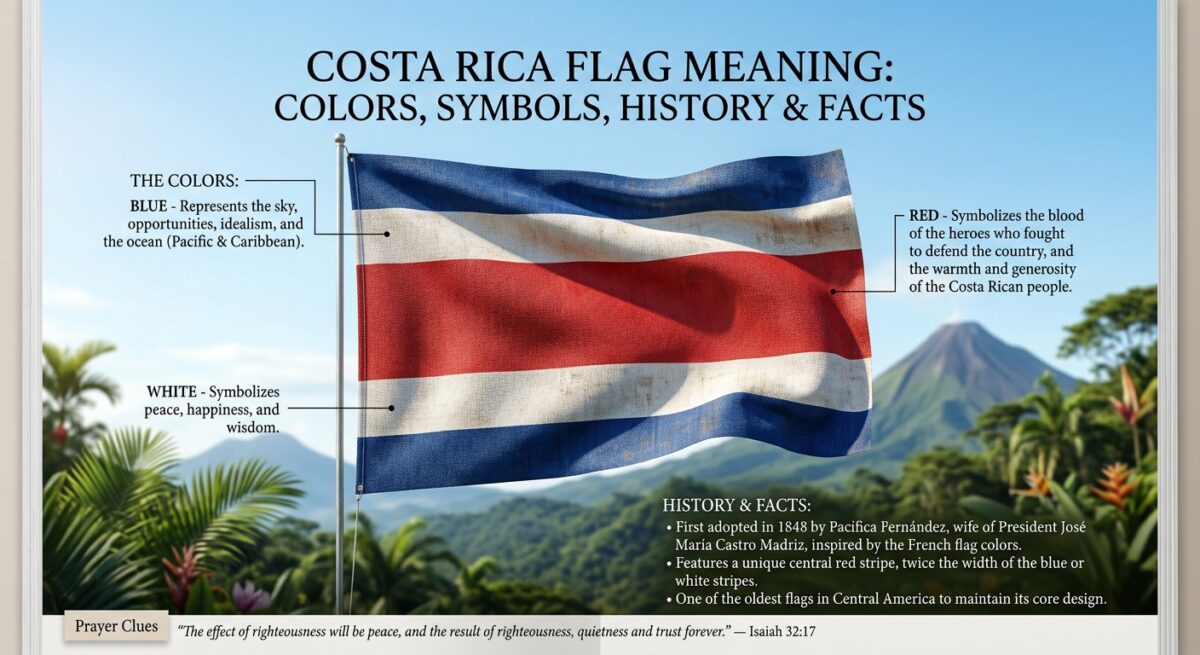
The Costa Rica flag meaning reflects the country’s history, independence, peace, and national identity. Its bold red, white, and blue colors are more than a beautiful design—they represent important values and ideas that have shaped Costa Rica.
The flag features five horizontal stripes, with blue representing the sky and ideals, white symbolizing peace and wisdom, and red expressing the courage, energy, and warmth of the Costa Rican people. The national coat of arms also adds important symbols connected to the country’s land, history, and future.
But why were these particular colors and symbols chosen, and what story does the flag tell about Costa Rica? As you look closely at each stripe and the coat of arms, you’ll discover how the Costa Rica flag carries a powerful message of freedom, peace, and national pride.
Costa Rica Flag Meaning: What Does the Flag Represent?
The Costa Rica flag meaning is closely connected with peace, freedom, national pride, and the country’s history. Its blue, white, and red stripes create a simple design, but each color carries an important idea about Costa Rica and its people.
The flag also includes the national coat of arms on its official state version. The emblem shows volcanoes, oceans, ships, and seven stars. Together, these details represent Costa Rica’s geography, independence, provinces, and national identity.
See Also: Yin Yang Symbol Meaning: Balance, Love, Life & Spiritual Symbolism
What Do the Colors of the Costa Rica Flag Mean?

The three colors of the Costa Rica flag are blue, white, and red. They are traditionally connected with the country’s ideals and national values. The colors also make the flag easy to recognize among other Central American flags.
Blue is associated with the sky and ideals. White represents peace, wisdom, and happiness. Red reflects the warmth, courage, and energy of the Costa Rican people.
| Color | Symbolic Meaning |
|---|---|
| Blue 🔵 | Sky, ideals, and aspirations |
| White ⚪ | Peace, wisdom, and happiness |
| Red 🔴 | Courage, warmth, and energy |
The Meaning of the Costa Rica Emblem
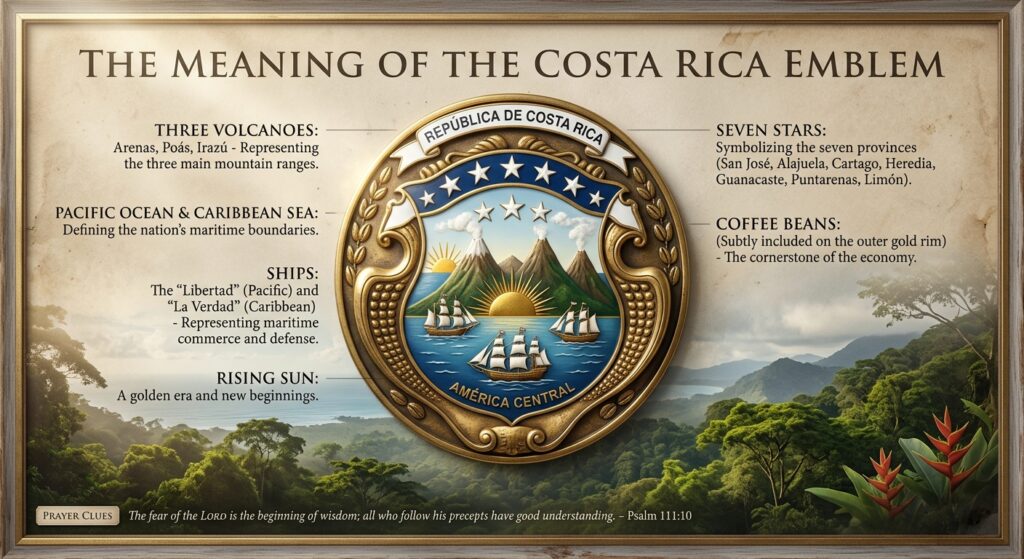
The Costa Rica coat of arms adds another layer of meaning to the national flag. It shows important parts of the country’s geography and history rather than being used only as decoration.
The emblem includes three volcanoes, two oceans, ships, a rising sun, and seven stars. These symbols help tell the story of Costa Rica as a country located between two major bodies of water and divided into seven provinces.
What Do the Volcanoes on the Costa Rica Emblem Represent?
The three volcanoes represent Costa Rica’s mountainous landscape. Volcanoes are an important part of the country’s natural geography and help show its rich and distinctive terrain.
They also give the emblem a strong connection to Costa Rica’s natural heritage. The mountains stand between the Pacific and Caribbean sides of the country.
What Do the Oceans and Ships Symbolize?
The two bodies of water shown on the emblem represent Costa Rica’s location between the Pacific Ocean and Caribbean Sea. This position has played an important role in the country’s geography and history.
The ships represent maritime activity and connections with other parts of the world. They help show Costa Rica as a country connected to international trade and travel.
What Do the Seven Stars on the Emblem Mean?
The seven stars represent Costa Rica’s seven provinces. They are an important part of the national coat of arms and show the administrative structure of the country.
The stars also make the emblem easy to recognize. When you see seven stars on the Costa Rican coat of arms, they are a reminder of the nation’s seven provinces.
Costa Rica Flag Symbol: What Does Each Part Represent?
Every major part of the Costa Rica flag has a purpose. The blue, white, and red stripes express national values, while the coat of arms adds geographical and historical meaning.
The Costa Rica flag symbol is therefore more than a national color pattern. It represents the country’s identity, independence, geography, peace, and connection with its people.
Costa Rica Flag Colors Meaning and Their History
The blue, white, and red design has historical roots. The colors were adopted during the development of Costa Rica’s national symbols in the nineteenth century.
The design was influenced by the colors associated with revolutionary ideals in Europe. Over time, these colors became closely connected with Costa Rican identity and national pride.
Read Also: Female Lion Dream Meaning: Spiritual, Biblical & Islamic Insights
Costa Rica Independence Day and Flag History
Costa Rica celebrates its independence as part of the independence of Central America from Spanish rule. Independence Day is celebrated on September 15, along with several other Central American countries.
The national flag became an important symbol of this independent identity. Today, the flag is especially visible during September celebrations, parades, school events, and patriotic ceremonies.
Who Designed the Costa Rica Flag?
The Costa Rica flag is traditionally credited to Pacífica Fernández Oreamuno, who designed the flag in 1848. She was the wife of President José María Castro Madriz.
The design was inspired by the French Tricolore. Costa Rica’s version used blue, white, and red to create its own national symbol while reflecting the political ideas of the period.
Official Costa Rica Flag: With or Without the Emblem?
Costa Rica has two commonly recognized versions of its national flag. The main difference is whether the coat of arms appears on the flag.
The state flag includes the coat of arms and is used by government institutions and official authorities. The civil version does not include the emblem and is commonly used by citizens and for general national displays.
| Flag Version | Coat of Arms | Typical Use |
|---|---|---|
| State flag 🇨🇷 | Yes | Government and official purposes |
| Civil flag 🇨🇷 | No | Civilian and general use |
Costa Rica Flag vs Thailand Flag: What Is the Difference?
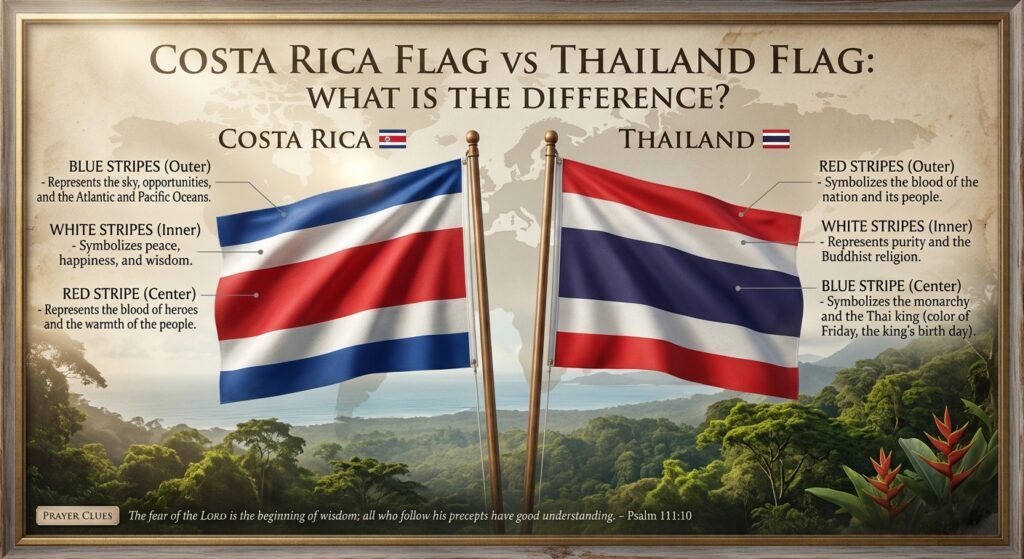
The Costa Rica flag vs Thailand flag comparison is common because both flags contain blue, white, and red horizontal stripes. However, their designs are arranged differently.
Costa Rica places a red stripe in the center, surrounded by white and blue stripes. Thailand places a wide blue stripe in the center, surrounded by white and red stripes.
| Feature | Costa Rica 🇨🇷 | Thailand 🇹🇭 |
|---|---|---|
| Center stripe | Red | Blue |
| Main colors | Blue, white, red | Red, white, blue |
| Stripe design | Blue-white-red-white-blue | Red-white-blue-white-red |
| National symbolism | Peace, ideals, courage, and national identity | Nation, religion, and monarchy |
Costa Rica Flag Facts You Should Know
The Costa Rica flag has several interesting details that make it more than a simple national banner.
- Costa Rica’s flag uses blue, white, and red.
- The official state version contains the national coat of arms.
- The coat of arms includes seven stars.
- The stars represent Costa Rica’s seven provinces.
- The emblem shows three volcanoes.
- The emblem represents the country’s position between two major bodies of water.
- Costa Rica celebrates Independence Day on September 15.
- The flag is an important symbol of Costa Rican national identity.
- The civil version of the flag does not display the coat of arms.
- The design has historical links to the French Tricolore.
Why Does Costa Rica Have Two Flags?
Costa Rica has a state version and a civil version of its national flag. The state flag displays the coat of arms, while the civil flag leaves it out.
This difference helps distinguish official government use from general civilian use. Both versions use the same recognizable blue, white, and red color pattern and represent Costa Rica.
What Does the Costa Rica Coat of Arms Represent?
The Costa Rica coat of arms brings several national ideas together in one image. Its volcanoes represent the country’s mountainous landscape, while the two bodies of water reflect its geographical position.
The ships point to maritime connections, and the seven stars represent the seven provinces. Other details, including the rising sun and surrounding elements, add historical and geographical meaning to the emblem.
Costa Rica Flag Symbolism in Culture and National Identity
The flag is an important part of Costa Rican culture and national identity. It appears during national celebrations, public ceremonies, school activities, sporting events, and Independence Day traditions.
For many people, displaying the flag is a simple way to show national pride. Its colors and symbols connect everyday celebrations with Costa Rica’s history, independence, and shared heritage.
Costa Rica Flag and National Pride
The Costa Rica flag is more than a government symbol. It represents a sense of belonging and connection to the country. During national holidays, flags can be seen throughout communities, schools, homes, and public spaces.
The flag’s message of peace and national unity is especially meaningful because Costa Rica is widely known for its peaceful national identity. It remains one of the most recognizable symbols of the country.
Costa Rica Flag Meaning in One Simple Explanation
In simple words, the Costa Rica flag meaning is connected with the country’s values, history, geography, and national pride.
Blue represents the sky and ideals. White is linked with peace and wisdom. Red represents the warmth, courage, and energy of the people. The coat of arms adds symbols of Costa Rica’s volcanoes, seas, ships, and seven provinces.
You Might Also Like: Pelican Dream Meaning: Spiritual, Biblical, and Symbolic Messages
Conclusion:
The Costa Rica flag meaning reflects much more than national colors. Its blue, white, and red stripes represent important values, while the coat of arms shares the country’s story through volcanoes, oceans, ships, and seven stars. Together, these symbols represent Costa Rica’s history, geography, peace, freedom, and national identity. From Independence Day celebrations to everyday displays, the flag remains a proud symbol of the Costa Rican people. Understanding its colors and symbols makes this beautiful national flag even more meaningful.
Frequently Asked Questions
What does this 🇵🇷 mean?
The 🇵🇷 emoji represents the flag of Puerto Rico. It is not the Costa Rica flag. Costa Rica’s flag emoji is 🇨🇷.
What is this symbol ₡?
The ₡ symbol is used for the Costa Rican colón, the official currency of Costa Rica. You may see it before prices written in Costa Rican colones.
Which country’s flag is 🇨🇮?
The 🇨🇮 emoji represents Côte d’Ivoire, also called Ivory Coast. Its flag has three vertical colors: orange, white, and green.
Why are there two flags for Costa Rica?
Costa Rica has a state flag with the coat of arms and a civil flag without it. They are used for different purposes.
What do the three colors on the Costa Rica flag mean?
Blue is associated with the sky and ideals, white with peace and wisdom, and red with the warmth, courage, and energy of the Costa Rican people.
What does the red color on the Costa Rica flag mean?
Red represents the warmth, courage, and energy of the people of Costa Rica. It gives the flag a strong and vibrant appearance.
What does the blue color on the Costa Rica flag mean?
Blue is traditionally associated with the sky and ideals. It can also suggest the country’s aspirations and hopes for the future.
What does the white color on the Costa Rica flag mean?
White represents peace and wisdom. It adds a calm and peaceful meaning to the national color combination.
What do the stars on the Costa Rica flag represent?
The seven stars on the coat of arms represent Costa Rica’s seven provinces.
Why does the Costa Rica flag look like the Thailand flag?
Both flags use blue, white, and red horizontal stripes, which can make them look similar. However, the stripe arrangement and symbolim are different.