

Easy-to-memorize means something is simple to understand, remember, and recall when you need it. Whether you are studying, preparing a speech, or learning important information, simple words and clear ideas can make memorization much easier.
When information is organized in a clear way, your mind can remember it more naturally. Short points, familiar words, repetition, and meaningful examples can all help turn difficult information into something easy to remember.
But what really makes something easy to memorize? Is it the length, the wording, or the way the information is presented? Let’s explore the simple techniques and ideas that can make learning faster, clearer, and more memorable.
What Does Easy to Memorize Mean?
Something that is easy to memorize is information you can understand, remember, and recall without too much effort. Simple words, short points, clear patterns, and meaningful examples often make information easier for the brain to retain.
Easy-to-memorize information is especially useful when studying for exams, learning new skills, preparing speeches, or remembering important facts. The goal is not simply to repeat something many times but to understand it and connect it with something familiar.
See Also: Bible Verses About Lust: Scriptures for Purity, Self-Control & Temptation
Why Are Some Things Easier to Memorize?
Some information is easier to memorize because it is simple, organized, interesting, or connected to something you already know. Your brain generally handles meaningful patterns and organized information more easily than random facts.
The way you study also matters. Breaking information into smaller pieces, creating associations, using active recall, and reviewing at spaced intervals can make difficult material easier to remember.
How to Memorize Things Fast for a Test Tomorrow

If your test is tomorrow, avoid trying to memorize your entire textbook at once. Start by identifying the most important topics, divide them into small sections, and focus on understanding the main ideas before trying to recall details.
After studying each section, close your notes and explain what you remember. Use short practice questions or flashcards to test yourself, then return to the areas you could not recall. This is usually more useful than simply rereading the same pages.
Easy to Memorize for Students
Students can make lessons easier to memorize by turning large chapters into short notes, questions, keywords, and simple diagrams. Instead of memorizing every sentence, focus on the main idea and the important facts that support it.
A useful approach is to study a small section, close the book, and try to explain it from memory. Repeating this process and reviewing the material later can help strengthen recall without making studying feel unnecessarily difficult.
Easy to Memorize for Adults
- Break complicated information into smaller parts.
- Use keywords instead of memorizing long sentences.
- Connect new ideas with things you already know.
- Use reminders, flashcards, or short notes.
- Explain difficult ideas in your own words.
- Practice recalling information instead of only rereading it.
- Review important information at different times.
- Get adequate sleep and take regular study breaks.
How to Memorize Things Easily and Quickly
Start by understanding what you are learning instead of immediately trying to repeat it. Divide the material into manageable chunks and identify a few keywords that represent each section.
Next, test yourself without looking at your notes. You can speak the answer aloud, write it from memory, or explain it as though you were teaching someone else. This makes your study session more active and focused.
How to Memorize 10x Faster
There is no reliable method that can guarantee everyone will memorize information 10x faster. However, you can make learning more efficient by replacing passive rereading with active recall and focused practice.
Try combining several useful methods: understand the concept, divide it into chunks, create associations, test yourself, and review it later. Studying with fewer distractions can also help you use your available time more effectively.
How to Memorize Fast in 5 Minutes
If you only have five minutes, focus on the most important information rather than attempting to learn everything. Read the key points once, identify the main keywords, and create a simple connection between them.
Then put your notes away and recall as much as possible. Check what you missed, review those points briefly, and test yourself once more. Five minutes may help with quick recall, but deeper learning usually requires additional review.
How to Memorize Notes in One Night
- First, organize your notes into the most important topics.
- Remove repeated or unnecessary information.
- Turn important points into short questions.
- Study one small section at a time.
- Close your notes and recall each answer.
- Mark the information you repeatedly forget.
- Review difficult sections again before finishing.
- Get enough sleep instead of relying entirely on an all-night study session.
Memorization Techniques for Studying
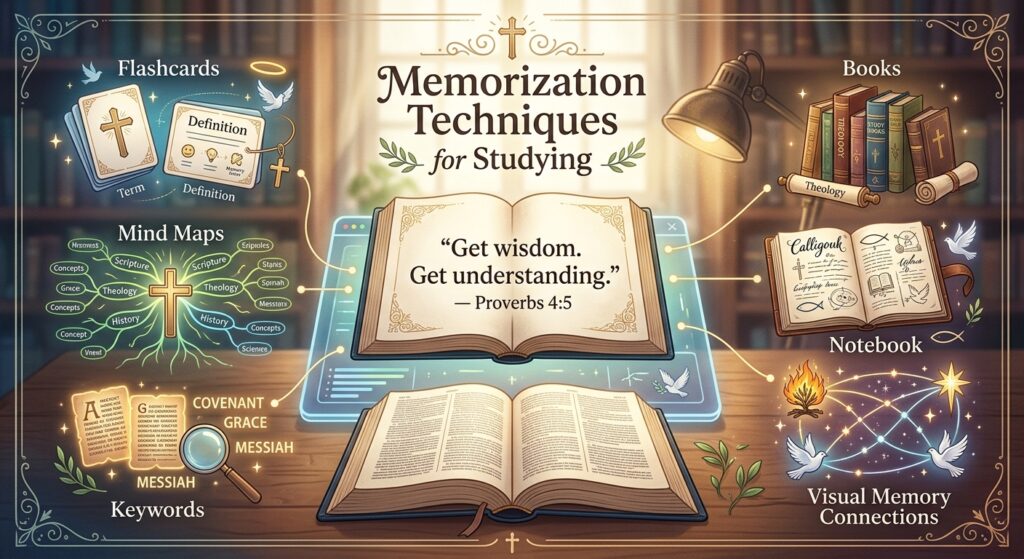
Effective memorization is usually more than simply reading the same information repeatedly. Techniques such as active recall, chunking, visualization, flashcards, and spaced repetition can make study sessions more purposeful.
Choose techniques according to the material. Flashcards may work well for definitions, while mind maps can help organize a large topic. Practice questions are particularly useful when preparing for an exam because they require you to retrieve information.
20 Easy-to-Memorize Techniques That Actually Help
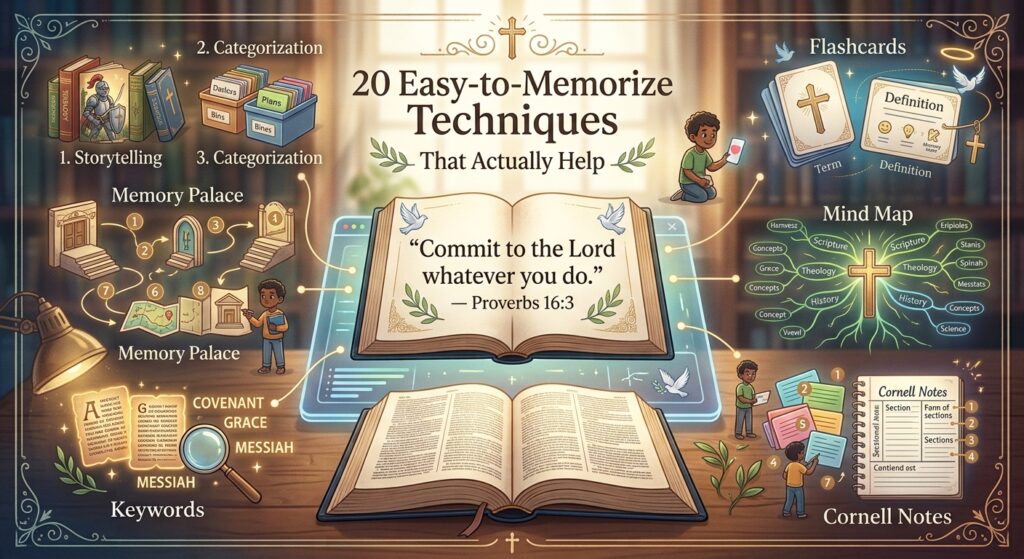
- Break information into small sections — Smaller pieces are easier to understand and recall.
- Use simple keywords — Choose a few words that remind you of the main idea.
- Create acronyms — Turn a list into a memorable word or phrase.
- Make information into a story — Connect separate facts through a simple sequence.
- Connect new ideas to familiar things — Use knowledge you already understand.
- Use flashcards — Ask yourself questions and check your answers.
- Practice active recall — Try remembering information without looking at it.
- Review information several times — Return to important material over time.
- Explain the topic in your own words — This checks whether you truly understand it.
- Write important points by hand — Summarizing can encourage active engagement.
- Create mental pictures — Imagine concepts as pictures or scenes.
- Use rhymes or patterns — Rhythms and patterns can make information memorable.
- Organize information into lists — Clear structure makes facts easier to follow.
- Study one topic at a time — Reduce unnecessary mental switching.
- Remove distractions — Give your attention to the material.
- Take short study breaks — Brief breaks can help you stay focused.
- Test yourself without looking at notes — This strengthens retrieval practice.
- Review difficult points more often — Spend extra time on weak areas.
- Teach the information to someone else — Explaining it can reveal knowledge gaps.
- Get enough sleep before an important test — Sleep supports learning and memory.
20 Easy-to-Memorize Tricks for Students and Adults
- Read the material once for understanding.
- Highlight only the most important words.
- Turn headings into questions.
- Answer questions from memory.
- Use short summaries.
- Group related facts together.
- Associate facts with images.
- Repeat information aloud.
- Make a simple memory map.
- Use examples to understand difficult ideas.
- Compare similar concepts.
- Practice recalling instead of rereading.
- Start with the hardest material while your attention is fresh.
- Review information before it becomes difficult to recall.
- Mix different types of practice.
- Use a timer for focused study sessions.
- Keep your study area organized.
- Avoid trying to memorize everything at once.
- Check yourself at the end of each study session.
- Do a quick final review before bed.
Easy Memorization Techniques Compared
| Technique | Best For | How It Helps |
|---|---|---|
| Active recall | Facts and definitions | Makes you retrieve information from memory |
| Flashcards | Short answers | Provides quick self-testing |
| Chunking | Long information | Divides large material into smaller parts |
| Acronyms | Lists | Makes several items easier to remember |
| Storytelling | Sequences | Connects facts through a meaningful story |
| Mind maps | Large topics | Shows relationships between ideas |
| Spaced repetition | Long-term learning | Reviews information at increasing intervals |
| Teaching others | Understanding | Helps identify gaps in your knowledge |
| Visualization | Concepts and processes | Creates memorable mental associations |
| Practice tests | Exams | Gives you practice retrieving answers |
How to Memorize Things Fast for a Test Tomorrow
When your test is only one day away, prioritize rather than attempting to memorize every detail. Review your syllabus, teacher-provided materials, important definitions, formulas, concepts, and topics that are most likely to matter.
Use a cycle of study → close your notes → recall → check → repeat. Spend more time on information you cannot remember, and leave some time for sleep because sacrificing rest can make concentration and recall harder the next day.
Read Also: Morning Devotional for Today: Begin Your Day With Faith, Prayer & God’s Peace
How to Memorize Notes in One Night Without Feeling Overwhelmed
Begin by separating your notes into three groups: information you already know, information you partly know, and information you do not know. Concentrate most of your time on the last two groups instead of repeatedly studying material you already remember.
Keep your notes short and focus on keywords, questions, examples, and main ideas. Take brief breaks and avoid putting unnecessary pressure on yourself to remember every single sentence perfectly.
How to Memorize Fast in 5 Minutes
For a five-minute review, choose only the most important facts or ideas. Read them carefully, reduce them to keywords, and create quick mental connections between the points.
After that, cover your notes and recall the information yourself. A short recall session can be useful for refreshing familiar material, but five minutes is not enough to master a large or completely unfamiliar topic.
How to Memorize 2x Faster
You may not literally memorize everything twice as fast, because learning speed differs from person to person and depends on the material. However, removing distractions and using active study methods can make your time more productive.
Instead of reading the same page repeatedly, read it once for understanding and then test yourself. Combine this with chunking, spaced review, flashcards, and practice questions to make each study session more effective.
What Is the 3-3-3 Memorization Rule?
The 3-3-3 memorization rule is not one universally agreed-upon scientific memory technique. Different websites, teachers, and study systems may use the term to describe different approaches.
Because of this, it is important to check what a particular source means by “3-3-3” before following it. For reliable memorization, techniques such as active recall, spaced practice, understanding, and practice testing have broader support.
Common Mistakes That Make Memorization Harder
Several study habits can make memorization less effective. Simply rereading notes for hours may create a feeling of familiarity without showing whether you can actually recall the information independently.
Common mistakes include studying with constant distractions, trying to memorize everything in one sitting, skipping practice questions, and avoiding difficult topics. Another mistake is sacrificing too much sleep when preparing for an exam.
How to Make Difficult Information Easy to Memorize
Begin by asking what the information actually means. Break complicated material into smaller ideas, identify the key terms, and connect each idea with an example, picture, story, or concept you already understand.
Then practice recalling the information without looking at your notes. If you make a mistake, check the answer, correct it, and try again later. Difficult material often becomes easier when you understand its structure instead of memorizing isolated sentences.
You Might Also Like: Heartfelt Prayers Before Meals & Dinner Blessings for Every Table
Conclusion
Making information easy to memorize starts with understanding, organization, and active practice. Break large topics into smaller parts, use keywords and associations, test yourself, and review important information over time. Students and adults can both benefit from flashcards, chunking, visualization, practice questions, and teaching others. If you have only a few minutes, focus on the most important points rather than everything at once. Most importantly, give your brain enough rest so you can concentrate, learn, and recall information effectively.
Frequently Asked Questions About Easy Memorization
What is the easiest way to memorize?
Break information into small parts, understand it, and use active recall to practice remembering it.
How to memorize 2x faster?
Use focused study sessions, active recall, and spaced review instead of relying only on repeated rereading.
What is the 3-3-3 memorization rule?
It is not a single standardized memory method; different sources may use “3-3-3” to mean different techniques.
How can I memorize in 5 minutes?
Focus on key points, turn them into keywords, and quickly test yourself without looking at your notes.
What is the fastest way to memorize notes?
Summarize the main ideas, divide them into chunks, and repeatedly practice recalling them.
Is reading something again and again good for memorization?
Rereading can build familiarity, but active recall is usually better for checking whether you can actually remember something.
How can students memorize answers easily?
Turn long answers into keywords and short points, then practice explaining the complete answer from memory.
How can I memorize a long list?
Group related items together and use acronyms, patterns, stories, or visual associations.
How can I remember what I studied the next day?
Review the material and actively test yourself rather than only reading your notes again.
Does sleep help with memorization?
Yes. Adequate sleep supports learning, attention, and memory, making it an important part of effective studying.