
Dreams have always held a special place in Islam. Many Muslims believe that some dreams can carry guidance, warnings, good news, or reminders from Allah, while others may simply reflect a person’s thoughts, feelings, and daily experiences. Learning about Muslim dream interpretation helps you understand these dreams in the light of Islamic teachings.
Have you ever woken up wondering why you saw a certain dream? Could it have a deeper meaning, or is it just your imagination? In this guide, you will discover the Islamic meaning of common dreams, what the Quran and Hadith teach about dreams, and how to understand them in a simple and meaningful way.
This article explains Muslim dream interpretation using easy words and trusted Islamic knowledge. You will explore the different types of dreams in Islam, their possible meanings, and important guidelines for interpreting them wisely while remembering that only Allah has complete knowledge of the unseen.
What Is Muslim Dream Interpretation?
Muslim dream interpretation is the process of understanding dreams according to the teachings of the Quran and the Sunnah of Prophet Muhammad ﷺ. In Islam, dreams are considered a part of human life, and some may carry spiritual messages, glad tidings, or reminders from Allah. However, not every dream has a hidden meaning, as many dreams are simply reflections of a person’s thoughts, emotions, and daily experiences.
Islamic scholars explain that dream interpretation should always be based on authentic Islamic knowledge rather than superstition or personal opinions. Since only Allah has complete knowledge of the unseen, dream meanings should be viewed as possible guidance instead of certain predictions. A balanced approach helps Muslims benefit from dreams while keeping their trust firmly in Allah.
See Also: What Does It Mean to Dream About a Crab? Spiritual, Biblical & Hidden Meanings
What Does Islam Say About Dreams?

Islam recognizes dreams as one of the signs of Allah’s wisdom and teaches that they can come from different sources. The Prophet Muhammad ﷺ explained that some dreams are from Allah and bring good news, some are from Shaytan to create fear and distress, and others come from a person’s own mind. Understanding this distinction helps Muslims avoid giving every dream a spiritual interpretation.
The Quran and Hadith encourage believers to respond to dreams with wisdom and faith. Good dreams should inspire gratitude toward Allah, while bad dreams should lead a believer to seek His protection. Islam also teaches that dreams should never replace the guidance of the Quran, the Sunnah, or sincere prayer when making important decisions.
Dreams Mentioned in the Quran
The Holy Quran records several dreams that played an important role in the lives of Allah’s prophets. One of the best-known examples is the story of Prophet Yusuf (AS), who saw the sun, moon, and eleven stars bowing to him. This dream was fulfilled years later and showed that Allah may reveal future events to His chosen servants through true dreams.
Another significant dream mentioned in the Quran is that of the King of Egypt, who saw seven healthy cows being eaten by seven lean cows. Allah gave Prophet Yusuf (AS) the wisdom to interpret the dream as a prophecy of years of abundance followed by famine. The Quran also tells the story of Prophet Ibrahim (AS), who saw himself sacrificing his son in a dream as a test of obedience to Allah.
What the Hadith Says About Dreams
The Hadith provides detailed guidance on the nature and interpretation of dreams. The Prophet Muhammad ﷺ said that a righteous dream is from Allah, a disturbing dream is from Shaytan, and another type comes from what a person thinks about during the day. These teachings remind Muslims that not every dream has a spiritual meaning or requires interpretation.
The Prophet ﷺ also taught believers how to respond to different kinds of dreams. If someone sees a pleasant dream, they should praise Allah and may share it with someone they trust. If they experience a frightening dream, they should seek refuge in Allah, lightly spit to the left three times without saliva, change their sleeping position if possible, and avoid telling the dream to others.
The Three Types of Dreams in Islam
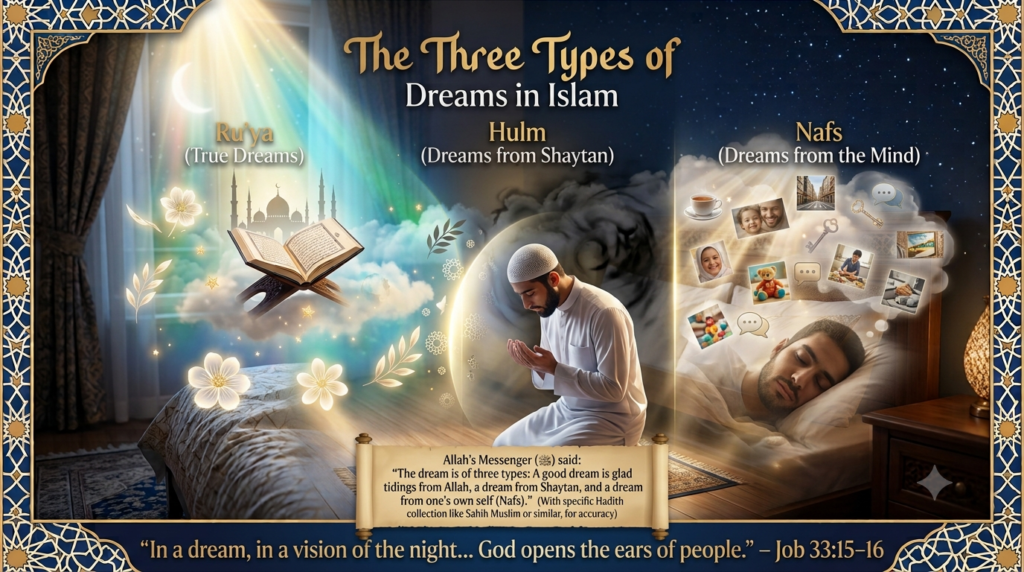
Islam clearly divides dreams into three categories to help believers understand their source and purpose. These are true dreams (Ru’ya) from Allah, frightening dreams (Hulm) from Shaytan, and dreams from the Nafs, which come from a person’s own thoughts and experiences. Knowing these categories prevents confusion and protects Muslims from false interpretations.
Understanding the three types of dreams also teaches believers to maintain balance. Instead of assuming every dream contains a divine message, Muslims are encouraged to compare dreams with the teachings of Islam and rely on the Quran and Sunnah as their primary source of guidance.
True Dreams (Ru’ya)
True dreams, known as Ru’ya, are considered a blessing from Allah. They often contain good news, encouragement, hope, or gentle reminders that strengthen a believer’s faith. These dreams usually leave the dreamer feeling peaceful, comforted, and spiritually uplifted rather than frightened or confused.
Although true dreams are respected in Islam, they are not a source of new religious teachings. The revelation ended with Prophet Muhammad ﷺ, so even a beautiful dream must always agree with the Quran and Sunnah. A Muslim who experiences a true dream should thank Allah, pray for goodness, and share it only with trustworthy people.
Dreams from Shaytan (Hulm)
- These dreams are intended to frighten or disturb the believer.
- They often involve fear, danger, sadness, or confusion.
- Nightmares are generally included in this category.
- Shaytan uses such dreams to create anxiety and weaken faith.
- These dreams should never be treated as predictions of the future.
- The Prophet ﷺ instructed Muslims to seek refuge in Allah after such dreams.
- Lightly spitting to the left three times is a Sunnah practice after a bad dream.
- Muslims should avoid sharing frightening dreams with other people.
- Performing voluntary prayer can help bring peace to the heart.
- Trusting Allah removes fear and protects believers from the whispers of Shaytan.
Dreams from Your Own Mind (Nafs)
Many dreams are simply the result of the human mind processing daily events, emotions, worries, and memories. These are known as dreams from the Nafs, or the self. For example, someone thinking constantly about work, family, school, or travel may dream about those same subjects during sleep.
Islam teaches that dreams from the Nafs usually do not carry a spiritual message. Instead, they reflect what occupies a person’s mind and emotions. Recognizing these ordinary dreams helps Muslims avoid unnecessary worry and prevents them from searching for hidden meanings where none exist.
Read Also: What Does It Mean to Dream About a Team? Spiritual, Biblical & Hidden Meanings
Why Do Muslims See Dreams?
Dreams are part of Allah’s creation and are one of the ways the human mind functions during sleep. Some dreams may encourage believers, strengthen their faith, or remind them to return to Allah. Others simply reflect personal experiences, emotions, and concerns from everyday life.
Islam teaches that dreams should increase trust in Allah rather than fear of the unknown. Whether a dream is pleasant or disturbing, believers are encouraged to respond with patience, prayer, remembrance of Allah, and reliance on His wisdom instead of making assumptions.
How to Interpret Dreams According to Islam

Dreams should always be interpreted according to the Quran, authentic Hadith, and the understanding of qualified Islamic scholars. Muslims should avoid relying on superstitions, fortune tellers, or unreliable dream dictionaries that promise fixed meanings for every symbol. The same dream may have different meanings depending on the dreamer’s life, faith, and circumstances.
Before interpreting a dream, a believer should ask Allah for guidance through sincere du’a and reflect on whether the dream encourages righteousness or causes unnecessary fear. Most importantly, Muslims should remember that only Allah knows the unseen completely, and no dream should ever be given more importance than the clear guidance found in the Quran and the Sunnah.
Important Note: Dream interpretations are symbolic and should not be considered absolute predictions. Their meanings may vary based on a person’s circumstances, faith, and life experiences. Only Allah has perfect knowledge of the unseen.
Common Dream Symbols in Islam and Their Meanings
- Water: Often symbolizes purity, knowledge, mercy, or blessings from Allah. Clean water is generally a positive sign, while dirty water may represent difficulties or spiritual struggles.
- Snake: Can symbolize an enemy, hidden danger, jealousy, or a difficult challenge. The meaning depends on the snake’s behavior and the dreamer’s situation.
- Rain: Usually represents Allah’s mercy, answered prayers, provision, and blessings. Heavy destructive rain, however, may symbolize trials or hardships.
- Mosque: Seeing a mosque often represents faith, guidance, worship, repentance, and drawing closer to Allah.
- Light: A bright light commonly symbolizes guidance, truth, wisdom, and increased faith. It may remind a believer to stay on the straight path.
- Fire: Fire may represent punishment, anger, temptation, or conflict. In some situations, it can also symbolize light, knowledge, or strength depending on the context.
- Trees: Healthy green trees often symbolize good deeds, righteous people, long life, and blessings. Dead trees may represent spiritual weakness or loss.
- The Moon: The moon can symbolize a righteous leader, knowledge, beauty, or guidance. It is sometimes associated with respected scholars or people of wisdom.
- The Kaaba: Seeing the Kaaba is usually considered a very positive sign of faith, acceptance of worship, spiritual growth, or the desire to perform Hajj or Umrah.
- White Clothing: Wearing clean white clothes often symbolizes purity, righteousness, forgiveness, peace, and sincerity in worship.
Positive Meanings of Dreams in Islam
Some dreams bring comfort, hope, and encouragement to believers. Islam teaches that true dreams (Ru’ya) are a blessing from Allah and may contain good news, reminders to remain patient, or signs that inspire a person to continue doing righteous deeds. These dreams often leave the heart feeling calm and grateful.
Positive dreams should increase a Muslim’s trust in Allah rather than create pride or false certainty. After seeing a good dream, a believer should praise Allah, make sincere du’a, and continue obeying His commands. A beautiful dream is a gift, but success still depends on faith, prayer, and righteous actions.
Warning Dreams in Islam
Not every dream brings good news. Some dreams may serve as reminders to repent, correct mistakes, strengthen faith, or avoid sinful behavior. Others may simply reflect personal fears or worries. Islam teaches that warning dreams should encourage self-reflection rather than panic.
If a dream causes fear or discomfort, Muslims should seek protection from Allah, ask for forgiveness if necessary, and continue performing acts of worship. A frightening dream should never lead someone to lose hope because Allah’s mercy is greater than every fear and difficulty.
Biblical vs Islamic Dream Interpretation
Both Islam and Christianity recognize that dreams can have spiritual significance. The Bible contains many examples of dreams given by God to prophets and righteous people, while the Quran also records important dreams, especially those of Prophet Yusuf (AS) and Prophet Ibrahim (AS). In both faiths, dreams can sometimes contain guidance or important lessons.
However, Islamic teaching clearly divides dreams into three categories: dreams from Allah, dreams from Shaytan, and dreams from one’s own mind. Islam also teaches that revelation ended with Prophet Muhammad ﷺ, so dreams cannot introduce new religious laws or replace the Quran and Sunnah. Every dream must be judged according to authentic Islamic teachings.
Can Dreams Predict the Future in Islam?
Islam teaches that Allah alone has complete knowledge of the unseen. While some true dreams may later come true by Allah’s will, Muslims should never assume that every dream predicts future events. Many dreams are simply reflections of daily thoughts or emotions and have no prophetic meaning.
A believer should never make important life decisions solely because of a dream. Instead, they should seek guidance through prayer, consultation, and the teachings of the Quran and Sunnah. Trust in Allah is more important than relying on dreams to know what will happen.
Is Every Dream Meaningful?
No, Islam teaches that not every dream carries a spiritual message. Some dreams are ordinary reflections of daily experiences, emotions, worries, or memories. These dreams come from the Nafs (the self) and usually do not require interpretation.
Understanding this prevents Muslims from becoming overly concerned with every dream they see. Rather than searching for hidden meanings in every dream, believers should focus on worship, good character, and obedience to Allah in their daily lives.
What Should You Do After Seeing a Good Dream?
When you see a pleasant dream that brings happiness and peace, thank Allah for His blessing. The Prophet Muhammad ﷺ taught that good dreams are from Allah and may be shared with people who genuinely care for you and wish you well.
Continue making du’a and performing righteous deeds after seeing a good dream. Do not become proud or assume the dream guarantees a certain outcome. Instead, let it strengthen your faith and encourage you to remain grateful and patient.
What Should You Do After Seeing a Bad Dream?
If you experience a frightening dream, remember that Islam provides simple guidance to help you find peace. Seek refuge in Allah by saying “A’udhu billahi min ash-shaytan ir-rajim,” lightly spit to your left three times without saliva, and avoid telling the dream to others.
Afterward, pray to Allah for protection and continue remembering Him. A bad dream cannot harm a believer who trusts Allah and follows the Sunnah. Place your confidence in His mercy, and do not allow fear to control your heart.
How Culture and Personal Life Affect Dream Interpretation
- Personal experiences influence the symbols seen in dreams.
- The same dream may have different meanings for different people.
- A person’s occupation can affect dream symbols.
- Family traditions may shape how dreams are understood.
- Emotional stress often appears in dreams.
- Cultural customs may influence dream imagery.
- Strong memories can reappear during sleep.
- Age and life stage may affect dream themes.
- Religious knowledge helps prevent incorrect interpretations.
- Islamic teachings should always take priority over cultural beliefs.
Common Mistakes People Make When Interpreting Dreams
One common mistake is believing that every dream is a message from Allah. Islam clearly teaches that dreams come from different sources, so not every dream deserves interpretation. Another mistake is depending on unqualified people, fortune tellers, or unreliable online sources that assign fixed meanings to every symbol.
Muslims should also avoid making major decisions based only on dreams. Marriage, business, travel, and other important matters should be guided by prayer, consultation, wisdom, and Islamic teachings rather than dreams alone. A balanced approach protects believers from confusion and false expectations.
Can Bad Dreams Be Prevented in Islam?
Islam encourages believers to prepare for peaceful sleep by remembering Allah before going to bed. Following the Sunnah at bedtime strengthens faith, brings comfort, and helps a Muslim sleep with peace of mind. While no one can completely stop dreams, these practices invite Allah’s protection.
A believer should sleep with trust in Allah, avoid sinful actions before bedtime, and make sincere du’a for protection. Even if a frightening dream occurs, remembering Allah and following the Sunnah removes fear and increases confidence in His care.
Read Ayat al-Kursi
Reciting Ayat al-Kursi (Surah Al-Baqarah 2:255) before sleeping is a well-known Sunnah. The Prophet ﷺ taught that whoever recites it at night will have Allah’s protection until morning.
Recite Surah Al-Ikhlas, Al-Falaq, and An-Nas
The Prophet Muhammad ﷺ regularly recited Surah Al-Ikhlas, Surah Al-Falaq, and Surah An-Nas before sleeping and blew over himself for protection. These chapters seek Allah’s refuge from all forms of harm.
Sleep with Wudu
Performing Wudu before going to bed is a Sunnah practice that brings spiritual cleanliness and prepares the believer to sleep in a state of purity while remembering Allah.
Make the Sunnah Bedtime Duas
Before sleeping, recite the authentic bedtime supplications taught by the Prophet ﷺ. These duas remind believers to place their trust in Allah, seek His forgiveness, and ask for His protection throughout the night .
You Might Also Like: What Do Dreams About Broken Glass Mean? Spiritual, Biblical & Psychological Interpretations
Conclusion
Muslim dream interpretation is based on the guidance of the Quran, the Sunnah, and the teachings of trusted Islamic scholars. While some dreams may bring good news or valuable reminders, others may simply reflect daily thoughts or emotions. Islam encourages believers to rely on Allah, avoid superstition, and interpret dreams with wisdom and caution Above all, remember that only Allah has complete knowledge of the unseen, and true guidance always comes through faith, prayer, and obedience to Him.
Frequently Asked Questions (FAQs)
What does it mean in Islamically dreams?
In Islam, dreams can come from Allah, Shaytan, or a person’s own thoughts. Their meaning depends on the type of dream and should be understood according to the Quran and Sunnah.
What are the four dreams to never tell in Islam?
Islam especially advises believers not to share frightening or disturbing dreams that come from Shaytan. It is also wise not to share dreams that may lead to jealousy, confusion, or unnecessary fear.
What are the three types of dreams in Islam?
The Prophet Muhammad ﷺ taught that dreams are of three types: true dreams (Ru’ya) from Allah, frightening dreams (Hulm) from Shaytan, and dreams from one’s own mind (Nafs).
What does Allah say about dreaming?
The Quran mentions dreams as one of Allah’s signs and records important dreams experienced by His prophets. However, only Allah has complete knowledge of the unseen and the true meaning of every dream.
Can Muslims interpret their own dreams?
Yes, but they should do so carefully and according to Islamic teachings. If unsure, it is better to seek guidance from a knowledgeable and trustworthy scholar.
Is every dream a message from Allah?
No. Islam teaches that only some dreams are from Allah, while others come from Shaytan or reflect a person’s daily thoughts and emotions.
Who is the most famous Islamic dream interpreter?
Imam Ibn Sirin is one of the most respected scholars known for his work on Islamic dream interpretation, although interpretations should always be compared with authentic Islamic teachings.
Should I act on a dream immediately?
No. Important decisions should never be based only on dreams. Muslims should seek guidance through prayer, consultation, and the Quran and Sunnah.
Can bad dreams harm a believer?
No. A bad dream cannot harm a believer who seeks refuge in Allah, follows the Sunnah, and places trust in Him.
What should I recite before sleeping for protection?
Muslims are encouraged to recite Ayat al-Kursi, Surah Al-Ikhlas, Surah Al-Falaq, and Surah An-Nas, along with the authentic bedtime duas taught by the Prophet Muhammad ﷺ.